

Relief teaching offers flexibility and variety, while full-time roles provide stability and career progression opportunities. Both paths attract teachers at different stages, and neither option is inherently better than the other.
The better fit often depends on your life stage, financial needs, and professional goals. For example, a parent returning to work may prioritise flexibility. Meanwhile, a graduate starting their teaching career might prefer the stability and development opportunities of a full-time role.
We’ll break down both options so you can decide which path suits you right now. By the end, you’ll understand how each role works across Australian schools and what trade-offs are most important.
Let’s start with the basics.
What Is Relief Teaching in Australia?
Relief teaching in Australia means working as a casual teacher who steps into classrooms when permanent staff are absent. In practice, you work across different schools, year levels, and subject areas on a day-to-day or short-term basis. One week you might cover Year 3 literacy, the next week you could be teaching food technology at a secondary school in a different suburb.
The variety means you experience different teaching environments without committing to one school long-term. As a casual teacher, you can also accept or decline bookings, work around other commitments, and choose which schools suit your teaching style.
Full-Time Teaching Roles: The Permanent Path
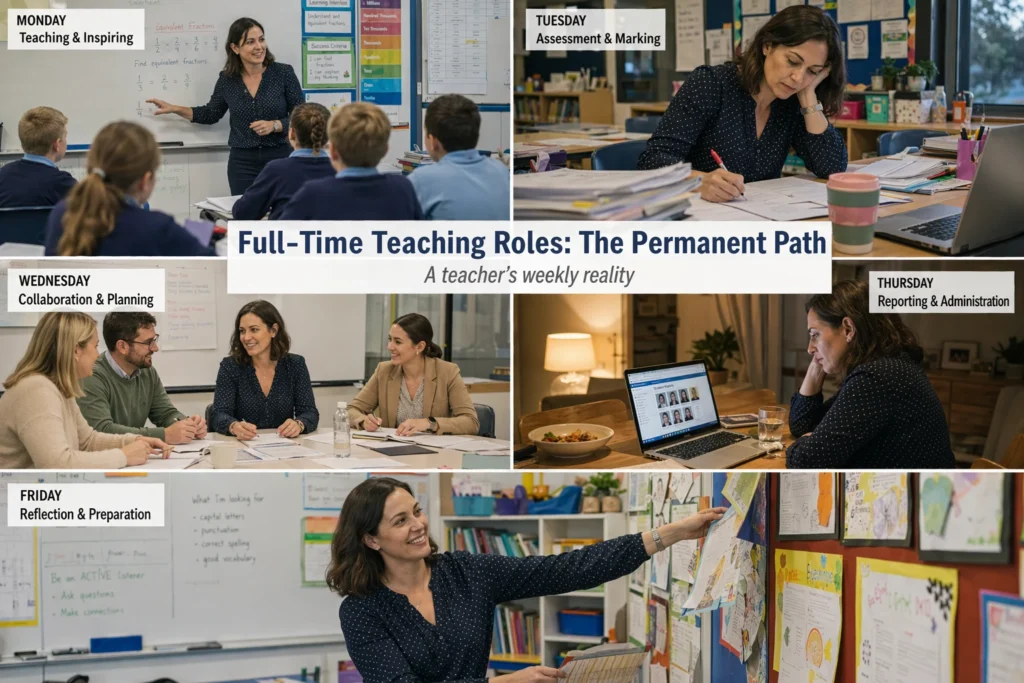
Full-time teaching positions involve ongoing employment at a single school (usually on a permanent contract). In this role, you teach the same classes throughout the year and follow curriculum planning and student assessment cycles. The consistency allows you to build deep relationships with students and contribute to school culture over time.
And unlike relief teaching, full-time roles come with responsibilities that extend beyond classroom delivery. You plan units, create assessments, mark work, write reports, and attend meetings beyond school hours.
The trade-off for this extra workload is stability: a guaranteed salary, paid leave, and access to professional development opportunities that help you grow your teaching career.
Relief Teaching vs Full-Time: How They Differ
The two roles share the same classroom teaching fundamentals but differ in structure and daily expectations. Here’s how relief teaching and full-time positions compare across 5 essential areas.
Flexibility vs. Guaranteed Hours
As we already mentioned, relief teachers have full freedom over their schedules. You can choose when and where you work and accept or decline bookings based on your availability. This flexibility appeals to teachers who value autonomy and control over their time.
In contrast, full-time teachers follow fixed schedules aligned with the school calendar, with limited flexibility during term time. This structure provides predictability but less day-to-day control.
Daily Rates vs. Salary Packages
Casual relief teachers typically earn higher daily rates than their full-time equivalents on a per-day basis. For example, in Victoria, casual relief teachers can earn up to $425.80 per day, according to Department of Education pay rates. Meanwhile, full-time teachers instead receive guaranteed salaries, paid leave, superannuation, and professional development funding.
Ultimately, this is a choice between immediate earning potential and long-term financial security with benefits.
Classroom Management Across Different Schools
Walking into a new classroom every day means that relief teachers need to establish authority quickly. There’s no time to build rapport over weeks, so classroom management depends on reading student dynamics fast and adapting on the fly.
Full-time teachers, on the other hand, build routines and relationships over time, which makes behaviour management progressively easier. The upside? Relief teaching develops adaptability and confidence in unfamiliar classrooms that you won’t gain from staying in one school.
Building Student Relationships Over Time

Relief teachers interact with hundreds of students across multiple schools, but rarely see the same faces consistently. This creates breadth of experience, but limited long-term connection building.
Experienced teachers in full-time roles, though, track individual student progress, celebrate growth, and form meaningful relationships throughout the year. Over time, this allows them to better understand student needs and support development more consistently.
Workload and Planning Responsibilities
As we mentioned, the workload for full-time teachers is demanding. They plan units, create assessments, mark student work, and attend staff meetings well beyond school hours. Some even spend their weekends preparing for the week ahead or catching up on marking.
As a relief teacher, your day ends when students leave. You follow the lesson plans left by the regular teacher, manage the classroom, and head home without taking work with you. There are no emails to answer at night or assessment deadlines waiting over the weekend.
Which Teaching Path Fits Your Life Right Now?
It depends on where you are in your career. The same qualification looks different at 28 than it does at 45, and the right path changes accordingly.
So let’s break down which option fits each stage of your teaching journey.
| Choose Relief Teaching If You Want… | Choose Full-Time If You Want… |
| Flexible schedules | Stable income |
| Variety of schools | Long-term career growth |
| Fewer take-home duties | Leadership opportunities |
| Part-time return to work | Strong school community |
Of course, most teachers don’t stay in one column forever. You might start with relief teaching to gain experience, then transition to full-time for stability. Later in your career, you might return to casual relief work for a better work-life balance.
A teacher we placed a few years back did exactly this. She spent two years doing relief work across Western Sydney primary schools, then moved into a permanent Year 5 role when she wanted a consistent income. She recently switched back to casual days now that her own kids are at school.
The better question was never which path is superior. Rather, it’s which one fits where your life is right now, and knowing you can change your answer later.
How Agencies Support Your Teaching Career Decision
Did you know that around 58% of school principals report ongoing teacher shortages?
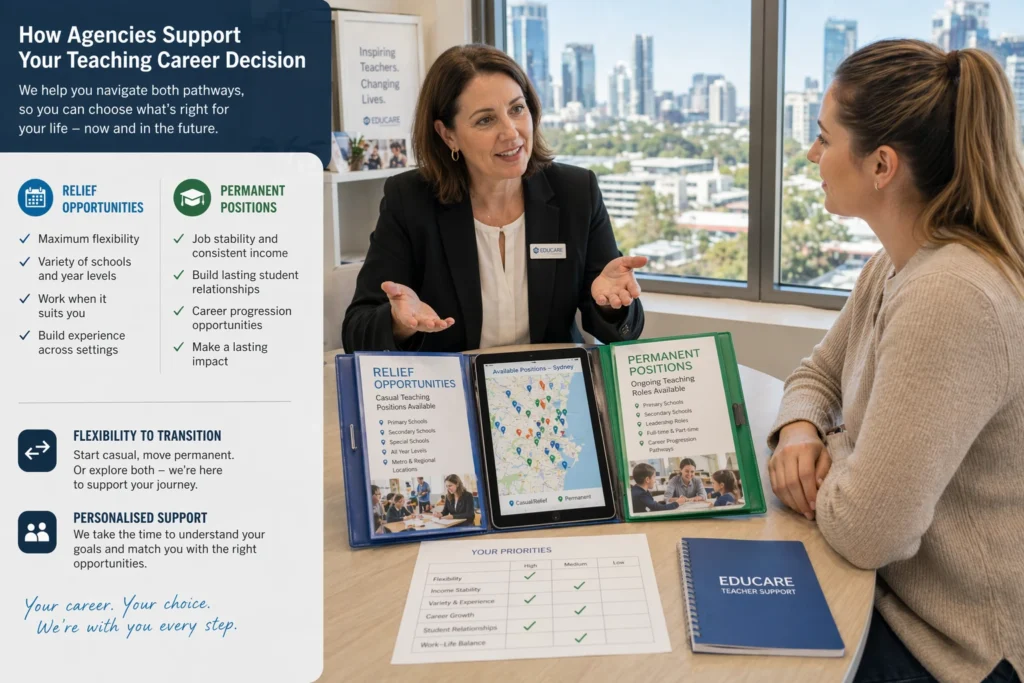
This demand means teaching agencies can offer you access to both relief and full-time opportunities without locking you into either path upfront. They match your current preferences with available positions, which means you can start with casual relief work and transition to permanent roles when you’re ready.
And the job search becomes simpler, too, since you’re working with one contact instead of applying to dozens of schools separately.
Find Your Perfect Teaching Role in Australia
Choosing between relief and full-time teaching rarely comes down to a single factor like income or flexibility. And the right answer looks different depending on where your life is right now. If you’re still weighing it up, that’s a conversation worth having before you commit.
Francis Orr has placed teachers across Australia in both relief and permanent roles. We know which schools are hiring, what they’re looking for, and how to match that against what works for you.
Reach out, and we’ll help you figure out the right next step.